(copy )Internet Censorship – An Analysis of 195 Countries
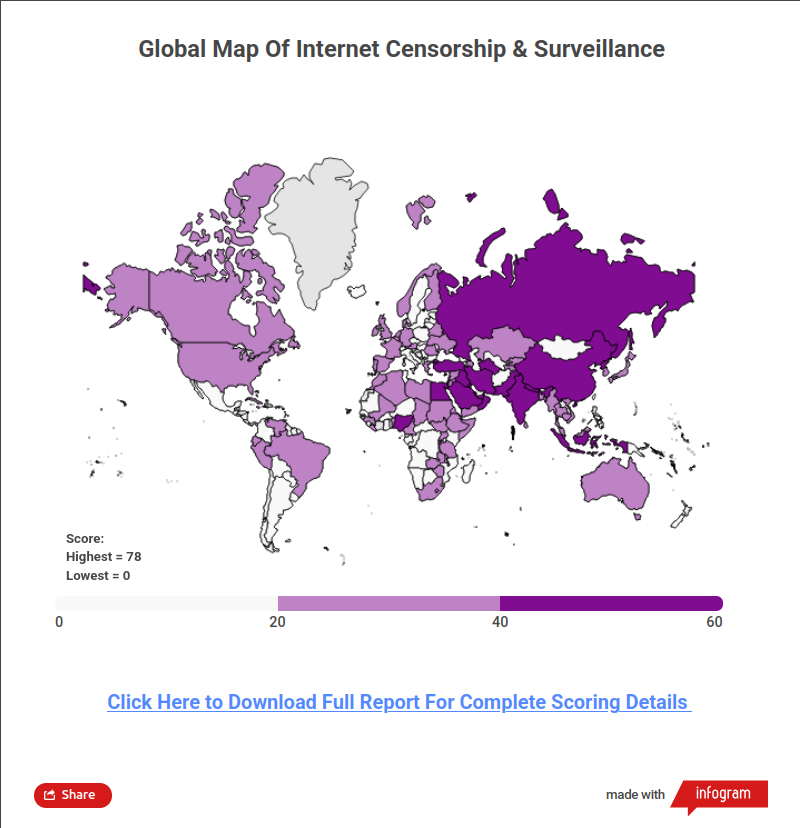
Global Map Of Internet Censorship & Surveillance
Around 4.66 billion people use the internet as a source of information, social interaction, entertainment, and more. But the truth is, not everyone in the world has the privilege of enjoying open and equal internet access.
In this study, we have conducted an analysis of 195 countries to see which have the most and least internet freedom. Our analysis includes bans or restrictions of VPNs, torrenting, social media, VoIP, and multiple websites and apps. Also taken into account are major internet censorship decisions taken between 2019 and 2020, along with user data and content restriction requests made to companies like Facebook, Twitter, and Google.
While the top spots aren’t surprising, some seemingly free countries make the cut as well. One thing is for certain: our online freedom is in danger more than ever!
Scoring Summary
Top Countries with the Highest Score
We have given scores, ranging from 0-65, to every country in our list on the basis of multiple factors, ranging from social media restrictions to bans on certain internet activities like the use of proxy or torrents. The following are the top 20 countries that have the highest scores.
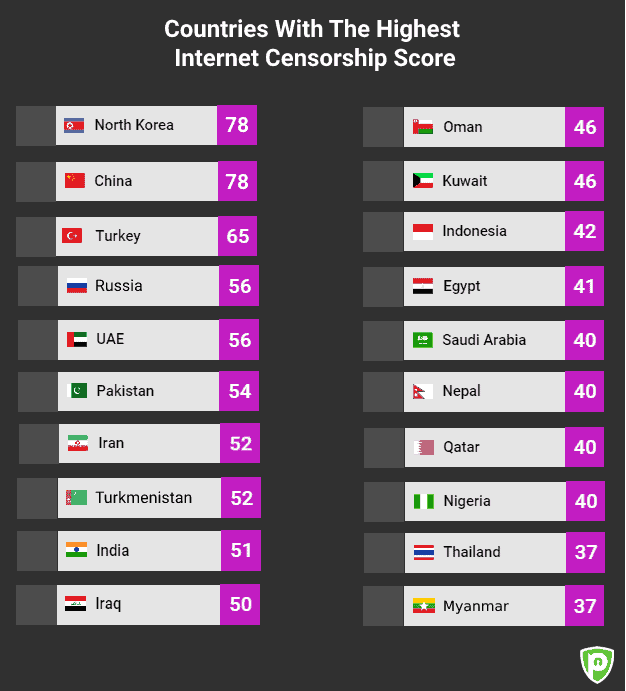
North Korea and China (78)
North Korea practices extreme forms of internet censorship, limiting the use of the internet to only foreign travelers and high government officials. The locals have access to only the national intranet service, Kwangmyong, which allows access to a limited number of web services.
China imposes strict restrictions against foreign websites like Google, social media services like Facebook and Instagram, VPNs, VoIP services, and everything in between. To gain a better control on its citizens’ internet activities, China encourages its users to use local alternatives, such as Baidu.
Turkey (65)
In recent years, Turkey has imposed censorships on websites and social media platforms. The country has even banned the use of encrypted messaging apps like WhatsApp for their public sector employees.
Russia and United Arab Emirates (56)
Russia has a history of blocking websites and IP addresses as part of its censorship policies. The country also blocks VPN services and proxy tools that offer private browsing to internet users. In 2018, Russia even fined Google for not taking down some blacklisted services.
As of late, the government aims to block Twitter in 30 days unless it removes a particular list of banned content.
The internet in the Middle East is not as censored as that in China or Iran. The country mostly blocks web services that are unethical or immoral in nature, such as gambling, fraud, and nudity. However, UAE has also often blocked messaging apps like WhatsApp because of its end-to-end encryption.
Pakistan (54)
Pakistan continuously blocks content that is either a threat to its national security or is blasphemous in nature. In 2010, Pakistan blocked Facebook temporarily to protest against a blasphemous contest on the social media platform.
On April 16, Pakistan blocked access to social media and google following days of anti-French protests throughout the country by a far-right Islamist pollical party. The sites temporarily blocked by the government include Twitter and Facebook.
Iran and Turkmenistan (52)
Iran is second to China in terms of censorship. The country has a continuous practice of blocking popular web services and social media platforms, such as Google, Facebook, TikTok, HBO, and other platforms of a similar nature.
Internet censorship in Turkmenistan can be considered draconian. The country has banned the use of encrypted applications, such as WhatsApp and Telegram. Moreover, netizens cannot use even VPNs or proxy tools for blocked websites.
India (51)
The state government of India possess strict control on internet censorship and surveillance ever since the 2008 bombings. To date, India has both temporarily and permanently blocked many websites and social media services. Recently, it has banned over 200 Chinese websites, games, and applications due to political conflicts.
Iraq (50)
The internet in Iraq was shut down in certain provinces to curb the threat brought upon by an extremist party during the war days. In fact, in many regions, some social media platforms like Facebook were also blocked. However, as soon as the level of threat to the region reduced, the shutdown was lifted along with social media platform bans.
Oman and Kuwait (46)
Like many Arab countries, Oman also placed a total ban on VoIP services due to security concerns. But due to Covid-19, the country has lifted bans from certain VoIP services. Apart from that, Oman practices limited to moderate restrictions for the use of VPNs and social media platforms.
Kuwait does block certain torrent websites, but it doesn’t ban the use of torrents. Likewise, the use of VPN services in Kuwait is completely legal.
Indonesia (42)
Indonesia observes a moderate level of internet censorship across the nation. Most actions of censorship are limited to only unethical and immoral platforms that promote nudity, gambling, and hoaxes. In certain situations, the Indonesian government has also banned certain social media apps, such as Facebook and Instagram. But the ban was later lifted.
Egypt (41)
Like most countries, Egypt often put restrictions on social media platforms mostly due to political reasons. At one point, the government also blocked over 34,000 websites that promoted an opposition campaign.
Nigeria, Saudi Arabia, Nepal, and Qatar(40)
Nigerian internet censorship policies are getting more severe with time. In 2019, an anti-social media bill was forwarded to the senate that seeks to empower the law enforcement agencies to ban some social platforms and even shut down the internet whenever the need arises.
Saudi Arabia mostly limits restrictions to copyright, blasphemy, and political issues. Like other Arab nations, the use of VoIP services is also prohibited in the country.
Nepal strictly prohibits the use of torrents or to be involved in any torrent related activity. Apart from the continuous ban on torrent, Nepal also practices social media censorship to a certain level. In fact, a bill has been proposed that would empower the government to block any social media platform at will.
Internet censorship in Qatar follows the same practices as that of the rest of Arab regions. The government has blocked torrents, and it also prohibits the use of VoIP services.
Thailand & Myanmar (37)
Internet censorship in Thailand is mostly limited to social media and web content. The government has a long history of blocking and removing content. Over the past few years, the Thai government has blocked some Wikipedia pages, Facebook groups, and content from other prominent sites in the country.
Following a military coup earlier this year, internet censorship is on the rise in Myanmar. There have been as many as five internet blackouts in an effort to curb pro-democracy protests in the country. Some social media sites such as Facebook and Twitter are also being blocked, leaving them unaccessible to millions of citizens.
Countries that Ban or Restrict VPNs